Nachtmusik (Computer Sounds for Nighttime)
Nachtmusik (Computer Sounds for Nighttime) is my second album, released on 9 October 2024. The album is my first concept album, focused on ambient music, which I explored briefly in my previous album, Burning the Daylight Oil. The album is in in fact practically the antithesis of the previous, mainly because while Burning was recorded over a long period of over a year-and-a-half in an attempt to increase the quality, Nachtmusik was recorded in a little over a month, work starting in late August and ending in early October of 2024. This was done because I wanted the album out by Autumn/Winter of that year, to fit the theme.
The recording process, as mentioned, was much faster than Burning the Daylight Oil. I would often start a track in the morning, and it would be finished by the evening. This was mainly because I thought less about structure and trying to make the songs as good as I could, but instead focused on making background, ambient music, as something to throw on while staying up late. I was heavily inspired by the works of Underworld, particularly their album A Hundred Days Off, which has a similar feel to it.
Background
As production closed on Burning the Daylight Oil, I re-listened to A Hundred Days Off by Underworld at the advice of a friend, and even though I had previously shunned the album, and I discovered that I actually rather liked it. In particular, I enjoyed the ambient-sounding element to it, which made it very suitable for putting on at nighttime, and so became my go-to choice at that time of day (or night, I suppose). Around a week after Burning was released, I upgraded my home studio in preparation for later albums. This involved getting new sounds, new software (both DAW and Synthesizer) and a new computer. Then, just a few days later, I woke up at 3:30 AM one morning, and after much tossing and turning, I put on A Hundred Days Off. Listening to it again made me think about my idea for an ambient album, and I realised if I wanted mine to be suited to night, like A Hundred Days Off, I should probably start work on it, considering it was late August and Autumn was just around the corner, meaning nighttime would be starting earlier and earlier. During that listening, I came up with the name "Nachtmusik", which came from the famous Mozart piece Eine Kleine Nachtmusik, which translates from German to "a little night music". I had already come up with the concept for the album artwork, and so I thought to myself, "best just get on with it".
Recording and production
The first track produced for the album, done on the same morning that I decided I would go ahead with making the album, was "Blinking in the Distance". It was made quite quickly, like most tracks that would be produced after it, although here it was because it was based on something I had written during the sessions for Burning the Daylight Oil. On the same day, I got access to some of my grandfather's old CD-Rs which he had burnt, mainly consisting of Christian talks. Already thinking of potential samples for the album, I took two discs.
Despite this motivation to make the album, "Blinking in the Distance" was the only track produced in August. Then, as September rolled around, I realised again that I should be working on the album. However, this time, I got into the rhythm (pun not intended) of producing the album, and soon I was making a song a day. This is notably the first time I was producing an album as such a fixed goal. Burning the Daylight Oil was originally just a project for a single, then it was an EP, then it was a Mini-Album, and then finally it was a proper full-length album. Here, I was certain from the beginning that I wanted to make an album, and that was the focus the whole way through.
By the time my motivation for the song-a-day system had died (and I had run out of ideas), the majority of the album was produced. A few more songs were produced following this, mainly when I came up with a new idea for a track. I also began properly mastering the tracks during this period, the first time I had done so for an album. The final track produced for the album was "Tune Out", finished just as the production period entered October, and more importantly, after I had announced the album's release date for the 9th of that month. After a few bug fixes done the following day, the album was finished. The tracklist was decided as I went along, and only one track was cut from the album.
Artwork
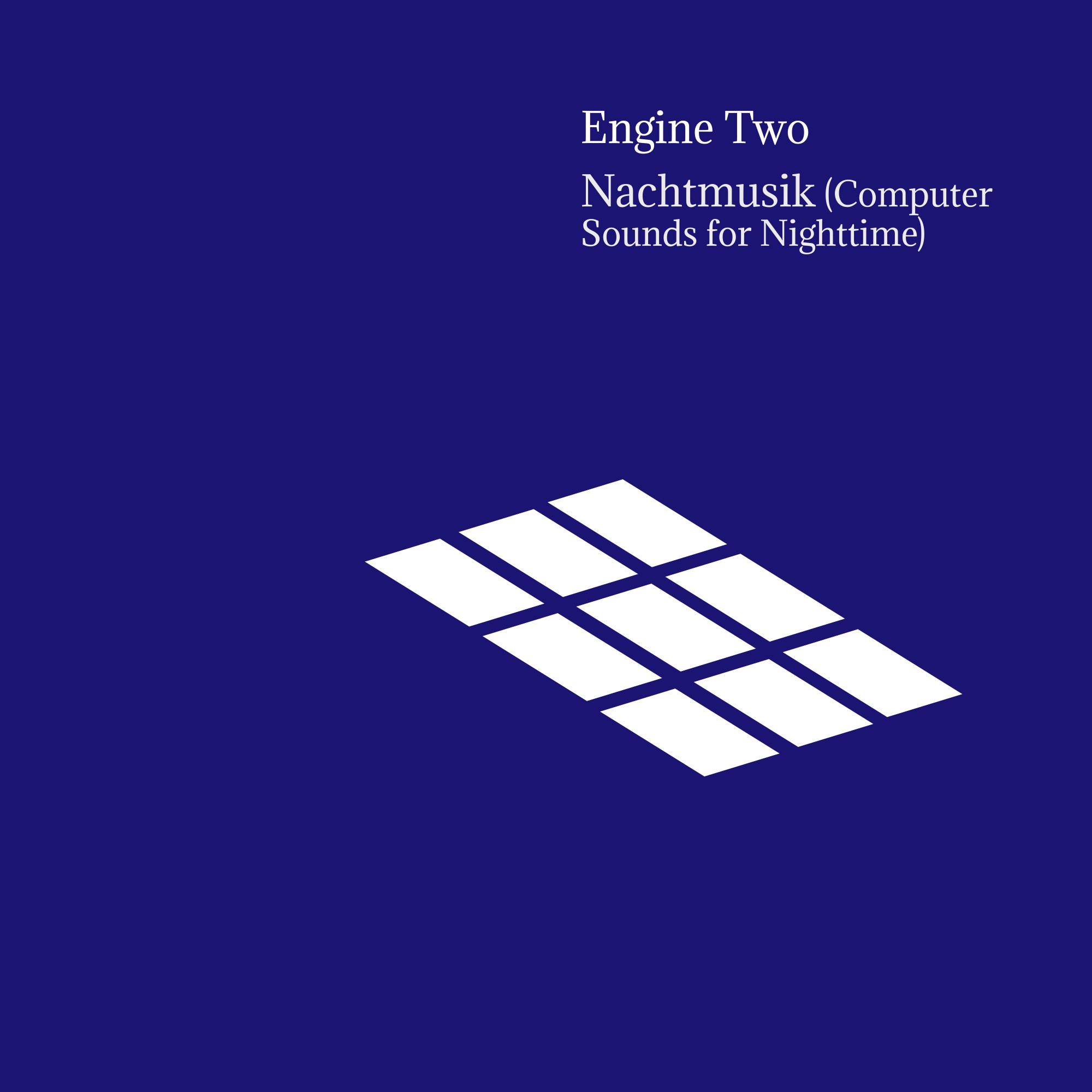
The cover features the reflection of a window against a blue background. Unlike my previous album covers, I drew out the shapes myself, mainly because it was simple enough. The original concept, based on an actual reflection of a window I had taken a photo of, was the reflection where half of it was against an invisible wall, and therefore would change the size and shape of some of the rectangles. I decided against it simply because it was far too complicated, and trying to get it to work in Blender actually made my head hurt.
Release
The release of the album was announced on my YouTube channel Tedster through a video titled "who says the end can't have a soundtrack?", released on 2 October 2024. The video featured footage taken at night, followed by an organ piece (Bach's Chorale Prelude BWV 659) as the album cover moves into frame, before announcing the release date as 9 October.
The album was released a week following the announcement, as planned, on 9 October 2024. This date was chosen as it was the birthday of John Lennon, whose song "Imagine" is interpolated at the end of the album in the hidden track "Imagine the Stars". Unlike my previous album, Burning the Daylight Oil, the album did not have any singles released before or after it, simply because I felt that as a concept album, no song should be separated from it, and they should all be heard first as one cohesive piece before the listener picks and chooses which tracks to replay. Even so, if I had to pick a track to release as a single, it would undoubtedly be "Irreverend".
Songs
"Tune In"
"Tune In" opens the album with various mechanical sounds. These were recorded from my amplifier and an old computer of mine. The track itself was recorded during the song-a-day period, however it broke the rule by being written over the course of two days. My excuse for as to why was because of the fact that the file corrupted during the first day of production, although in a strange way that the file was still openable and playable, and yet it didn't play properly. After copying the tracks over to another file, I finished work on the first half of it.
I then began work on the second part, with the slap bassline and slower tempo, as a separate track entirely, with the distorted crash cymbal intro intact. However, I didn't have any ideas for it, and what I tried didn't work, so I instead used it as the second part of "Tune In". The slap bassline was originally just a placeholder, but it stayed because I liked it. The bassline itself is a pretty common one, used in tracks like "Love Thang" by Banji Boys and "Sex on the Streets" by Pizzaman. Similarly, the main bassline of the track is inspired by the one featured in the "Skoolz Out Mix" of "Night Skool" by Meccaheadz. After a bit of editing and time stretching to make the transition work, the two parts were joined up.
"Irreverend"
A few years ago in 2022, Maxi Jazz, the vocalist for the band Faithless (famous for hits such as "Insomnia" and "God is a DJ"), passed away at the age of 65. I was saddened by this news when I heard it, especially as it now meant Faithless really was just the producer duo Rollo & Sister Bliss, and so they would have to look for other vocalists. Yes, Maxi had left before their previous album was released, but he wouldn't be recording any music anymore, solo or with Faithless. I always liked Jazz's vocals, and so it was disappointing to know he wouldn't appear on another one of Faithless' records.
More recently, Faithless put out a song as a tribute to him, called "I'm Not Alone", and I… really didn't like it. Listening to it again now, it feels like something out of the local panto, and not really a professional record. When I heard it upon release, just as I was starting work on the album, I decided I would make my own tribute to Jazz, and do my very best to make it better than what Faithless had put out.
A little later down the line, I started work on the track one evening. I sampled the drums from the end of the Sasha track "Ohmna", double tracked them and put them through some filters. From there, I added a bassline, and then Jazz's rap from "Reverence". Upon hearing the combination, I really felt it didn't work well, and even after trying other samples and other ways of arranging it, I still felt it just didn't sound good. By the time I went to bed, I was thinking about abandoning the idea. I decided to sleep on it, and the following morning looked at it again. I added one synth pad, and suddenly I felt the track might actually work. I kept working on it throughout the day, and by that evening, it was finished.
"Repetitive Beats"
After the whole song-a-day thing finished, I was quite demotivated. Then, on one Sunday where I was doing absolutely nothing, I told myself to make a track for the still-incomplete album, since I had nothing better to do. I wrote a chord progression, and I'm not entirely sure what it was, the progression or the instrument it was being played on, but I instantly thought to myself, "that's a drum and bass track". I tracked down a standard drum and bass sample, and put it over the track. While I was filtering the sample, I discovered that I could mess with the EQ settings to create a very cool effect, and so I decided that would be part of the track. After writing some melodics and adding a sample from a video discussing the Criminal Justice and Public Order Act 1994, I messed about with the EQ live. Then I added the melodics back, with some more for good measure, and then back to the EQ messing. In the second EQ-messing section, I edited the drum sample a little (using skills I'd learnt from And the Pandemonium Continued), including adding an Amen Break reference, which is barely audible through the EQ.
"Infidelity Marble Run"
Early in the production stage, I borrowed two of my grandfather's Christian talk CDs to sample. Before I had picked them out, I came up with the name "Infidelity Marble Run" as just a random meaningless phrase. However, when I saw a CD with the word "fidelity" written on it, I knew instantly I had to use that as a sample. The CDs were the first samples I found for the album, and I got to producing the track shortly after I had listened to the two and picked out bits that were worth sampling. The track didn't take long to produce, and was finished in a day or two.
One thing worth noting is that the quality of the voice recording changes between sections, and this is because one CD (the one not discussing fidelity) was obviously recorded in a much better way than the other. No filters were applied to either recordings, so what's on the track is what was on the CDs. Also, at the start of the CD discussing fidelity, there was a notice about piracy and illegal broadcasting that played for around two minutes that I had to sit and ignore, knowing full well I was listening to it for that exact purpose.
"My, How the World Spun"
"My, How the World Spun" was made late in the album's production, mainly because I just wanted to sample Steve Jobs, who I always felt was a great speaker and marketer. I spent a while on the morning of 21 September listening to Jobs talk on various YouTube video uploads, and it was only when I found a radio interview with him that I found something that I felt was really worth sampling. I still have a massive playlist of Steve Jobs talks that I compiled while trying to find the right sample!
I drew influences from tracks like "Frontier Psychiatrist" for the usage of drum samples, and the title from the typical villain speech you'd hear from some rich billionaire in an action film, which is the way some view Jobs.
"Silence in Stalingrad"
During the album's production, I listened to an interview with John Major that had taken place recently. I enjoyed the interview, and found several parts of it interesting. In particular, Major's comments on Brexit, and on Ukraine. I decided I wanted to sample his comments on Ukraine, and did so in "Silence in Stalingrad". I had also been looking into sampling Major's rival towards the end of his tenure as prime minister, Tony Blair. In particular, I had been listening to his final Labour conference speech in an attempt to find a sample. While at first I gave up as I was unable to find one, I later revisited it and found a section which I could sample, mainly because Blair didn't mention Labour in it, and I didn't want the track to be any more political than it already was.
The track was one of the last ones produced for the album, and is technically the penultimate track produced for it, as I started on it, then "Tune Out", and then the album was finished. However, "Stagger" was finished after "Silence in Stalingrad", despite starting work on the former before the latter. Since the track was such a late addition, it was rushed onto the album and sent out. If I had had more time to think about it, I would have taken time to think about cutting it from the album, as I feel it is the worst track on it.
"Jazz for Later"
"Jazz for Later" was the final track produced in the song-a-day period. Unlike most tracks for the album, I had no idea for it and it came about solely from a chord progression I wrote after around forty-five minutes at the keys. However, after I wrote it, I felt that it was too jazzy for the album, and sounded like something you'd hear in the background of a CGP Grey video. As such, I titled the file "jazz for later", and left it there. That evening, I came back to the file, with no new ideas still, in an attempt to turn it into a track for the album. After changing the arrangement around a little, I actually managed to get it to work, and I went from there. I added some drums (with a sextuplet hi-hat pattern, which I'd been wanting to do on a track for a while), a sample from a random old video about the history of Jazz that I found, and with a little more work the following day, the track was finished.
"Blinking in the Distance"
Towards the end of the sessions for Burning the Daylight Oil, I wrote a small melody and then discovered an instrument that made it sound like it was straight out of an Underworld song. I titled the file "long", after Underworld's "Dark & Long", which I felt it sounded similar to (or at least the "Dark Train" version, anyway). I tried working on it during those sessions, but I couldn't get other things to work with it. I eventually left the file as production on the album finished its main stage, and I focused on the tracks I had already recorded and prepared them for release.
On the day I started work on Nachtmusik in August 2024, I had another look at the file, with no other ideas for songs just yet. I decided what I had made for it during the Burning the Daylight Oil sessions wasn't good enough, and deleted what I had, apart from the main melody. I slowed it down to a much slower tempo, and then changed a few settings in the synthesiser. I added some other elements, including the beeping sound that runs through it and gives the track its name, which was originally a candidate for the title of a future release. Notably, between sections, these sounds will make a strange noise before continuing as normal. This sound is actually a bug in the software that I'm using that occurs when the rate of echo is changed while the sound is still playing, but I didn't try and fix it because I liked it.
"The Chapel Across the River"
After not producing a single song since "Blinking in the Distance", I started work again on the album in September with "The Chapel Across the River". It was written in an afternoon where I had nothing better to do, while the name came about while I was on a trip in Paris a year prior. As I was working on it, I added a snare drum sound which I had been saving for another track on a future release, mainly because I really wanted to use it. To disguise it so it wouldn't be recognised when I actually used it, I applied some echo, and discovered I could create a strange effect with a certain kind of dotted echo, and so I used that. Once again, the strange sounds that accompany the end of the track are caused by a bug in the software, but they stayed because I liked them.
"Stagger"
During the sessions for the album, I regularly listened to a track called "Stagger" by Underworld, featured as the closing track for their album Second Toughest in the Infants. Listening to it affirmed not just how good the track was, but how suited for night the track was. I was a little annoyed that I couldn't just put it on the album, because it was so perfect for it. I decided I would do the next best thing, that being making a cover of it. And to be clear, it's not really a cover, more a glorified remix. But, I really wanted the track on there, so it's the best I could do without having to sing the words myself (oh, the horror!).
Work on the track actually started as a completely different song, which ended up sounding like something you'd hear in a trailer for a kids adventure film, before stopping abruptly and what would become "Stagger" fading in. I removed the intro because I felt it didn't really fit the sound of the album. Luckily, the sound used for the start of the original "Stagger" was the default Roland TR-909 ride cymbal sound, so I could very easily get a hold of it and use it for my cover. From there, the main track was difficult to work, and went through a couple rewrites and rearranges before it got to the final version you hear today, making it the track on the album that took the longest to produce. The structure remained roughly the same throughout, but I was originally a lot more lenient with the amount of Hyde's vocals that I used.
"Tune Out"
"Tune Out" was, funnily enough, the last track produced for the album. I had had the idea from basically the beginning of the project, that being a shameless rip-off of "Ess Gee" by Underworld, but the track in question is a two minute acoustic guitar solo, which might be difficult to replicate for someone who's never played guitar in their life. When the time finally came around that I had to write it, I wrote the first few phrases and played them through the software's internal acoustic guitar sound, and hated it. In fact, I hated it so much that I named the file “shitout”, closed it there, and thought about trying another idea (which I didn't have). Trying later with a piano sound made no difference. It was only even later when I gave up the whole “real instruments” facade and put it on the first synth bell sound the software had that I realised the track might actually still work. With the actually decent form of the track under my belt, I sat down and improvised almost all of the track in a couple takes. While originally it was going to feature a bass note underneath it, listening to it on its own made me realise how good the silence between each phrase was, and so decided against it. I added the closing build-up and ending, along with the sounds I had recorded, and finished the track just a day after I had confirmed the release date for the album.
"Imagine the Stars"
Early in the sessions for the album, I made a throw-away track which sounded like something from Undertale. It was based off of a cool sound I found in the software I was using, and mainly made just to experiment with it. I put some basic chords over it, and then stole the chords from John Lennon's "Imagine" to see how that sounded. It was actually rather good, and so I left it as just a little demo. As work on the album continued, I decided it would be a hidden track at the end of the album, there to symbolise "what if you didn't go to bed, but went outside instead?" Then, when time came to come up with the release date of the album, I set myself the date of October 9th, Lennon's birthday, as a nod to the inclusion of the track.
Released: 9 October 2024
Recorded: August–October 2024
Length: 79:33
- "Tune In" – 10:06
- "Irreverend" (feat. Maxi Jazz) – 8:14
- "Repetitive Beats" – 7:41
- "Infidelity Marble Run" – 8:00
- "My, How the World Spun" – 5:40
- "Silence in Stalingrad" – 6:25
- "Jazz for Later" – 5:01
- "Blinking in the Distance" – 4:25
- "The Chapel Across the River" – 4:34
- "Stagger" (feat. Karl Hyde) – 6:13
- "Tune Out" (includes "Imagine the Stars") – 13:45