Where Do We Go From Here?
This is the current project that I'm working on, and although its title has not been released yet, it is known by its tagline "Where do we go from here?". The project is the result of around a year of hypothesising potential follow-ups to my previous mainline studio album, Nachtmusik, with the main theme being simply that there is no theme, and that the eventual album will consist of music which I, over the course of a year, decided to make, regardless of genre.
Background
After my first Engine Two album, Burning the Daylight Oil, I had a few ideas for a follow-up, one of which was an ambient concept album, eventually titled Nachtmusik. Nachtmusik was a success (not commercially, but solely in my eyes), and I wanted to push on to the next idea for an album. The problem I had, however, was with the new promise of a concept album, there were simply too many ideas. I won't list all of them here, simply because they could still happen, but among them was a release to follow-up And the Pandemonium Continued, a concept album set on a spaceship with each song being a different room in the ship, a synth-pop virtual band's debut album, a trance album called Millenium at a Service Station, or a follow-up to Nachtmusik set on a nightbus. What's notable about each of these albums is that they're totally stylistically different from each other. The first is influenced by The Prodigy and Fatboy Slim, the second by the Orb and ambient-era KLF, the third by Kraftwerk, the fourth by Vincent de Moor and Ferry Corsten, and the fifth by Underworld and Aphex Twin. Any of these ideas could still happen (apart from the fourth, which developed into this project), and there's a further three which I haven't mentioned here because they show more promise and/or I still really want to do them. All these ideas were brought about by my widening music taste - when making Burning the Daylight Oil, all I really listened to was trance and house, with a little breakbeat/big beat on the side. Now I listen to those, plus synth-pop, plus ambient music, plus tons of rock and pop, and just a dash of classical. My music taste is all over the place, and I found myself wanting to do three concept albums at once. Plus, after making trance remixes of "Crash Down" and "Popcorn" for The Defibrillated Collection, I came to the conclusion that I was bored of writing the same old formulaic trance replica, and found myself gravitating more towards the 15-minute epics of Underworld or the Orb. The problem was, I essentially had no motivation to commit to any one of the album ideas and focus my music on one particular style for ages. So the question I found myself asking was, "Where do I go from here?"
The answer to this question began to form in summer 2025, when I bought a couple 12" singles from a nearby record store. One of them was Three 'n One's "Soul Freak", backed by "Drop & Roll" on Side B. B-sides in electronic music are pretty rare. Most of the time, the artist will just get someone to remix the original and have that be the B-side, rather than making another original themselves. And as music's moved into the digital world, the concept of sides in the first place has become abstract. Three 'n One also had an album from around the same time, which shared its title with the single I'd bought, and having a look at the album I thought about something I'd noticed in the many electronic music albums, particularly trance albums, that I'd been listening to. The album contained practically all the A-sides the band had released up until that point: 6 among a 12-song tracklist. I'd imagine the band weren't thinking about a potential album when they released the first of those singles two years prior, but with the buildup of singles and a push to make album tracks, the band had an album on their hands. I liked this concept of just stacking up singles until you had an album, rather than making an album all in one go and then releasing singles from it.
This, in turn, led me back to the oldest idea I had, that being the album I originally intended to follow-up Burning the Daylight Oil with. The working title (although I hadn't worked on it at all) was Turn, as in a turn in my music making style. The album, stylistically, was going to be the same as Burning the Daylight Oil: 80 minutes of whatever I'd made in the studio for the past year or two. With all the ideas I had floating around for releases, what if I approached albums like this; making what I like, whenever I liked, releasing singles as I went, then finally putting the whole thing together into an album. In the end the album would contain some new original tracks - it's not just going to be a glorified compilation album - but it would be a casual approach, with no style, no drive, no concept, nothing. That sounded like a pretty sweet deal.
Recording and production
"Station Arrival"
Recording for the album began when I had a day off in October which I decided to devote entirely to writing music. I'd sit down and spend all day working on some songs - maybe I'd make an EP, or even an album at a stretch. In the end, on this mild October day, I completed just one song - a song which I'd already started on, intended for a friend's game before it got too long and out of hand, and just needed another few hours of work to finish. I did that in the first few hours of the day, and then couldn't come up with anything else for the rest of it. Thinking throughout the day, I at first wanted to slate this as a B-side and then write the A-side for it. The problem was, even though I had an idea for the A-side, I just couldn't really get it to work. By the evening, I had decided to release the track as it was with no B-side. The following morning, I came up with the title "Station Arrival", a nod to the train-themed game it was originally going to be included in, and released it that evening. The track in the end was a standard '99 trance track which I rather liked, despite getting bored of writing for the genre. It used some interesting sounds, including the Roblox bass patch made famous in its early days (an idea I'd stolen off a song from Flood Escape 2), plus a melody that took several attempts to get right.
"Strawberry Fields Forever"
Strangely, I made this song after I made the following one, "Sleep", because I thought "Sleep" was far too much of a tonal jump from "Station Arrival". Seeking a middle-man to mellow out the mood before reaching "Sleep", I conceived the idea of an ambient cover of "Strawberry Fields Forever" with a classic text-to-speech robot singing in the style of Louis Zong's "Hello World". I'd discovered the text-to-speech robot while working on "Sleep", where I wanted some words in the song and discovered the inbuilt text-to-speech feature on my Mac, complete with ancient algorithms from the pre-MacOS days that created the exact sound I wanted. "Strawberry Fields Forever" is a Beatles song I've always admired, primarily for its wonderful chord progression in the verse, which unfortunately goes underrepresented in the original. Take 7 of the song features the chord progression much more prominently, and that was the main inspiration behind my version - the Candyflip version also had some influence. I had also been playing with the song a bit in the Burning the Daylight Oil sessions, but I never intended to make a song out of it then.
The first sound you hear in the song was my first attempt to get the 'ambient' sound I wanted working, before it segues into the second attempt. I tried a few pieces of software to get the singing robot to work, but all ideas fell through, and mostly led to AI sites. In the end, I simply took the output of the text-to-speech feature and pitch shifted it manually, creating a kind of weird effect that made the song seem quite comical to the people I played it to. The funniest part was probably the backing vocals, which were just a selection of pitch-shifted "aah"s. I kept them in because they worked well for the texture, but turned them down because otherwise you could hear what sounded like the thing dying when it reached for the high note! Originally, the synth that plays the melody alongside the singing was just a guide track while I worked on the vocals, but I felt that they really helped ground the listener (and made the shoddy pitch-shifting job sound a bit better), so they stayed in. The drums were all done live on an electronic kit, with the output fed via MIDI into my DAW so I could customise the sounds and panning. It took a few takes to get it right, primarily because I didn't really grasp how Ringo's simplicity on the original helped keep it going, and I played with complicated grooves. In the take I eventually chose, I laid off the complicated stuff, sticking to Ringo's simple style, and only indulging myself in a bit more bashing in the final section, where it seemed appropriate. The double-tracked maracas in the final section are actually beads in the hand of an old teddy bear played very close to the microphone, which I added when I felt the section needed a little more highs, and the double-tracking was simply because it felt like a just nod to the Fab Four's studio stylings. The section itself was a direct nab from the Beatles' own Take 7 version, which ends the same way. In both versions, this section is my favourite because it puts that chord progression which I love so dearly on full show. And to close, the classic Mellotron flute opening from the original is included because I just had to, followed by reverbed sounds of a single synth singing the chorus, which was included because I left it like that by accident, and then discovered just how good it sounded and decided to keep it.
An idea I also had was to include an entire second section, the same size as all that was before it, that would act as the counterpoint that the original had between light psychedelic to "John's had one too many lads". This section would have included actual singing, by me (although it would be less singing and more screaming through several layers of insulation for maximum experimental insanity), including singing parts of it in reverse, use of time stretching in the same way breakcore does, layers upon layers of synthesisers… all that good stuff. Naturally, with how ambitious it all was, I didn't even attempt it. I called it a day with the first half, and even though at first I felt it wasn't substantial enough to be a single all on its own, in the end I decided to put it out.
One thing to note - the version on YouTube has a bit of a mastering bug with the bass drums mixed way too loud. Upon the album's eventual release, this will be corrected (because YouTube doesn't just let you go back and change these things).
"Sleep"
As mentioned above, "Sleep" was made before my cover of "Strawberry Fields Forever", but was delayed because I felt it was a bit too much of a tonal jump from "Station Arrival". This track was released on New Year's Eve 2025, and done so because it was exactly a year after I made the original chord progression. I was bored in the latter hours of the night in 2024, and frankly the Graham Norton Show isn't much to watch when you don't care for any of the celebrities on it, so I sat down at the keyboard and worked on some chords for a while. The chord progression in "Sleep" was among the bits I saved to a file called "job for next year". In summer 2025, I made a short, three-minute demo version of the song, which was originally then going to be included as an album track for this album's eventual release, again as I didn't see it fit to be a single. However, in November, after releasing "Station Arrival", I came back to it to try and turn it into something which had single potential. The problem I had was that it was quite simple: it had the chord progression, a percussion bit in the middle (inspired by "Tour de France" by Kraftwerk which I was listening to in the summer), and that was about it. If I was going to turn it into a single, it needed to be much longer and have much more to it. So, I thought back to "Tour de France", which is similar in terms of what elements it has, that being quite little. I thought about how Kraftwerk structured that song, and tried to recreate it. I created a counter-chord progression, like "Tour de France" does, and then moved onto the next section in the Kraftwerk number, which had vocals. Now, I'm not a vocals guy - in Nachtmusik I broke new ground by including vocal samples, so singing is a far out idea for me. Therefore, I instead thought about using an old-sounding text-to-speech robot. After a little searching online, I discovered that MacOS comes with one installed which included old MacTalk algorithms which had the exact sound I wanted. So, I fed some nonsense lyrics which I'd written down ages ago into it, and we were on a roll. From there, I no longer needed to consult Kraftwerk for how to do the structure; I was simply running wherever the musical direction took me.
However, as I was working on the third verse, I realised the lyrics began getting kind of… meaningful. I was writing out lyrics on the fly based on Karl Hyde-esque phrases I'd written down a while back, but this third was developing into a piece about the fear of death and unconsciousness. And so came the title of the song, "Sleep". I added one more verse at the very end which deals with this directly, and the song was finished. With a bit of mixing and panning shortly before its release (after putting it off for ages), I released the song exactly a year after I wrote the original chords, a suggestion a friend had when I told him the story about how I came up with it.
"Don't Waste Your Time"
This song is the purest example of what I was trying to capture with this project. After hearing a bass sample while listening to The Allman Brothers' album Eat a Peach, I decided it would make a good big beat song, like that of Fatboy Slim or the Chemical Brothers. After assembling samples from all across my music library, the track basically just… happened. I didn't really make it to be part of this project or because I had motivation to make new songs, I just had this new idea, and over the course of a week, I made it a song. Personally, I think it's one of the best songs I've ever made.
The only thing about this song worth mentioning here is that the final drum break at the end is actually a live drum solo; I mapped the drum sounds from the sample I was using to parts of my electronic kit and then played a solo using only those drums (kick, snare and crash).
"Rainwater"
“Rainwater” started essentially as a downtempo jam, over the top of a distorted drum break which I'd recorded. I just started adding melodic parts, and then didn't really stop. A little while after this, I listened to the Man With No Name album Moment of Truth, and was inspired to make a Goa/Prog Trance track of my own. Trance relies on lots of melodics working together, and at that point I couldn't really be bothered to make my own, so I decided to turn the jam which I'd made into the song by dropping the drum sample, speeding up the project, and changing the synth sounds used. I made the intro, but afterwards tried to incorporate a long vocal sample of a full verse, since it felt appropriate, but couldn't get any to work. The track remained unfinished like this for some time as I still wanted to use a vocal sample but couldn't be bothered to find one.
In June 2026, I decided I really needed to lock in (as the kids say) and try to make enough songs for an actual album. Rather than starting on a new idea, I went back to this song to try to finish it off. I started by abandoning the idea for a vocal sample, and just kept going with the track as an instrumental. Now, since all the melodic parts had already been written, all I really had to do was just sequence the whole thing properly, and the song would be finished. So in the span of about an hour, the song was complete. There were a few last minute changes, such as changing the synth sound for the main melody, but that was about it.
"Circuits"
One of my favourite video games is Wipeout 2097; I have sampled sounds from it in the past, and the artwork of this project is inspired by it. But one of my favourite things about the game is its music, which is a collection of the best and brightest in techno at the time. The previous game in the series, the original Wipeout, had a soundtrack almost entirely composed by Tim Wright, under the name CoLD SToRAGE, who, by his own admission, had never made techno before. Somehow, he still absolutely knocked it out the park, making one of my favourite techno tracks, "Messij". With its distinctive melodic bass which opens the track and its use of different sections (rather than the techno standard of the same thing for five minutes), it was and still is a memorable track. "Circuits" was my best attempt at re-creating "Messij", and I have to admit, I actually did pretty damn well with it.
The first part of the track which I made was the drum part, which is itself a combination of three drum breaks and a drum machine. Then, after banging my head on the wall repeatedly whilst announcing that I'd never write a note of music again, I wrote the opening bassline. At first, like "Sleep", I tried to copy the structure of "Messij" pretty closely (especially that really punchy kick drum), but by the end the song had become its own beast. The opening samples of a count-in (and all the "Come on!"s and "Hit it!"s sprinkled throughout) were an idea I'd had for a long time, tracing back to a never-finished attempt to make a proper house track in 2022 while I was dealing with one of my biggest bouts of writer's block. The B section was made by mapping a vocal sample to a keyboard and playing a bunch of notes (most importantly, with a huge amount of stereo delay over it) - the full sample was actually a phrase which I'd recorded off of BBC Radio 2 which I wanted to use at some point, but I only ended up using the very start of it. This use of stereo delay was inspired by a small part of "Whitney Joins the JAMs" by the Justified Ancients of Mu Mu.
For me, while the track certainly does hold on in the first half, it really kicks in with the introduction of that 90s Korg M1 piano halfway through. Originally the piano was just an attempt at making another new section, like in "Messij", but once I heard the chord progression playing out of it, I knew it was going to define the rest of the track, which it then did. I ended up in a similar situation as my old song "The Brighter Side of Things" from And the Pandemonium Continued, where five minutes in I had reached the natural end point of the song, but I couldn't let myself just stop it there, so one more section had to go on the end, making the song seven minutes long.
The song, like all good breakbeat tracks, finishes with an off the wall vocal sample which has little connection to the rest of the song. The sample comes from (the Netflix dub of) the anime Neon Genesis Evangelion, where the protagonist Shinji mutters, "Why do we have to get all worked up and be loud like this?". I was re-watching Evangelion while working on the song, sometimes literally watching an episode, working on the song some more, then watching another episode, and at some point I decided I wanted to include a sample from it. Before watching episode 11, I declared that I would sample one line of dialogue from the episode, since I hadn't got around to finding a good one yet, and I chose that one, the joke being that the song is so stupidly loud and fast by my standards that Shinji is asking "why we can't just go back to the nice non-threatening ambient stuff". The artwork for the single was also fully nicked from the GUI on the computers in Evangelion (as any fan should immediately recognise), which is one of my favourite parts of the series.
Artwork
The artwork for this project is heavily influenced by the style of the Designers Republic, a design team who have worked on Wipeout (and Hardwar) and worked with Gatecrasher, Aphex Twin and Pop Will Eat Itself. I was most influenced by their Wipeout work, and even stole a few fonts from it! However, unlike the extreme visual noise featured in Wipeout (just look at this poster), I opted for a sense of simplicity, with the title, single number (an idea inspired by the KLF's Pure Trance series) and basic polygon artwork being the only features atop a grey background. The polygons would reflect the single's name or theme - for "Station Arrival" is the puffs of smoke from a steam engine, for "Strawberry Fields Forever" it's… well, strawberries, and for "Sleep" it's a crescent moon and the constellation of Casseopia. Each artwork would also contain two unique colours - one was the main colour used in the title and number, while the other was used somewhere in the artwork, and would be the main colour for the next release.

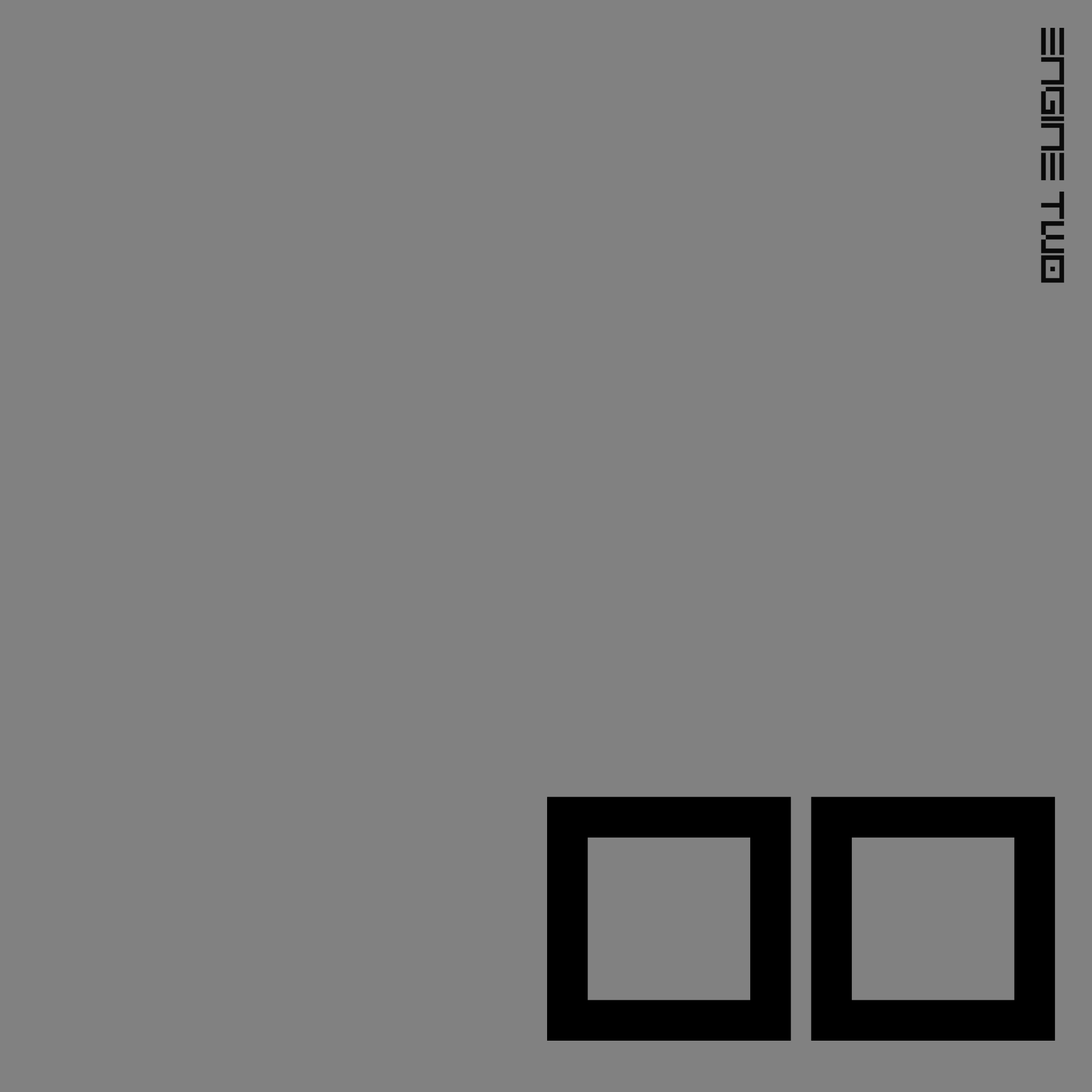
The template of all single releases from this project.
Recorded: October 2025–present
The singles thus far:
- "Station Arrival" – 12:11
- "Strawberry Fields Forever" – 5:58
- "Sleep" – 11:20
- "Don't Waste Your Time" – 7:47
- "Rainwater" – 7:56
- "Circuits" – 7:40